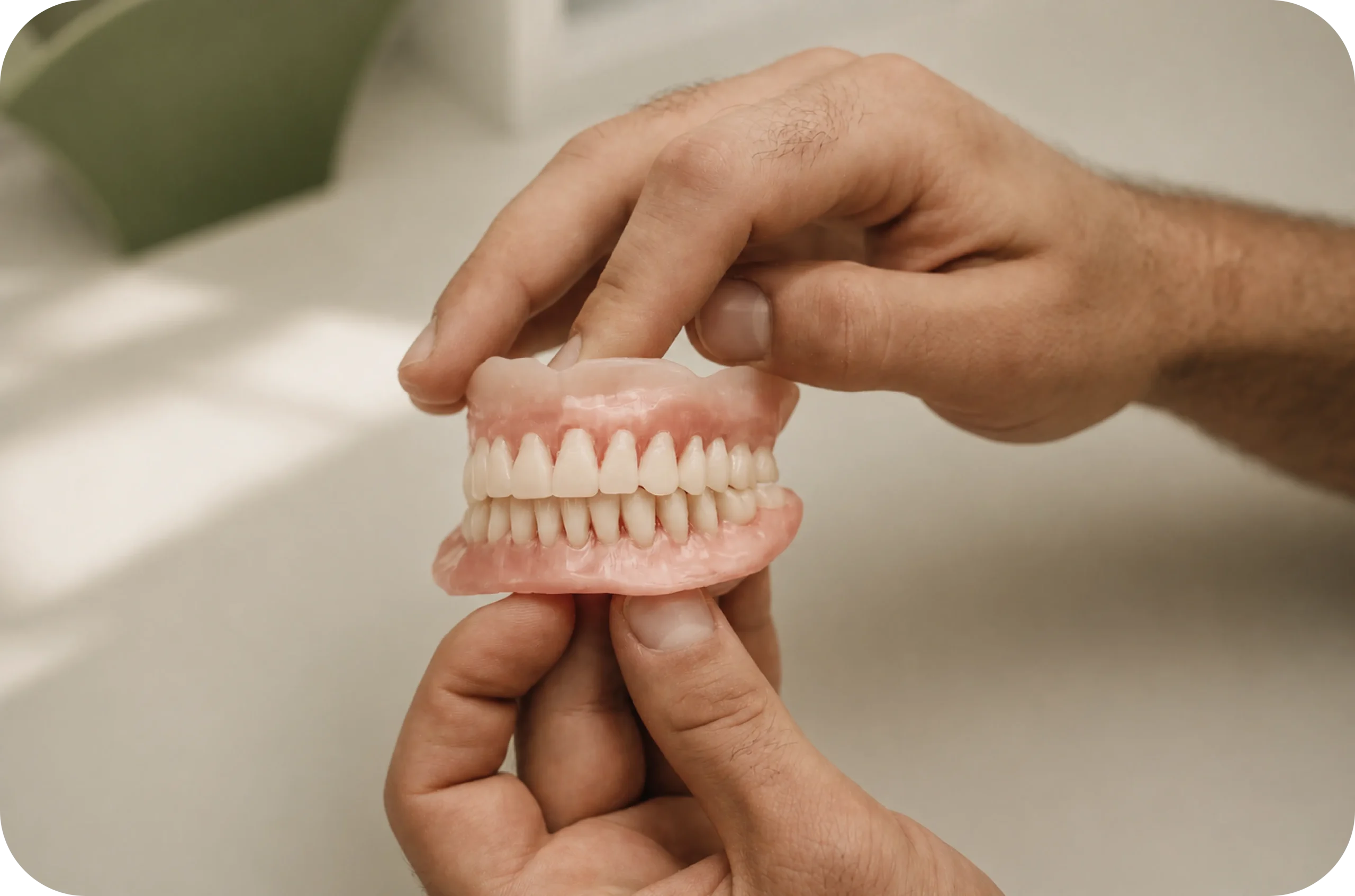
A removable dental prosthesis is a solution designed to replace missing teeth, helping to restore chewing function, improve smile aesthetics, and promote clearer speech.
Unlike fixed dental prostheses, it can be easily removed by the patient, making cleaning and maintenance easier.
It is a widely used option in cases of partial or complete tooth loss, valued for its accessibility and its positive outcomes in oral health.
Types of removable dental prostheses
Removable prostheses come in several types, each adapted to the specific needs of the patient. The choice depends mainly on the number of missing teeth and the overall condition of the dentition.
Removable partial dentures
They are indicated for replacing a few missing teeth. They are supported by the remaining natural teeth and the gums, using a metal or resin framework, ensuring good stability during chewing.
Complete removable dentures
They are used in cases of complete tooth loss in an arch. They are designed with a resin base adapted to the gums, ensuring comfort, proper fit, and adequate support.
In addition to restoring chewing function, they help restore the natural appearance of the smile, contributing to the patient’s well-being and self-confidence.
Advantages and disadvantages of removable dentures
Like any dental treatment, removable dentures have both advantages and certain limitations.
Advantages of same-day fixed teeth
More affordable cost compared to fixed solutions or implants
Easy to remove, which simplifies daily hygiene
Rapid restoration of chewing function and aesthetics
Suitable for various clinical situations, including significant tooth loss
Disadvantages
Possible movement or instability during chewing
Need for rigorous hygiene to prevent gum problems
Less effective stability compared to fixed or implant-supported prostheses
Adjustments may sometimes be required over time to maintain comfort and effectiveness